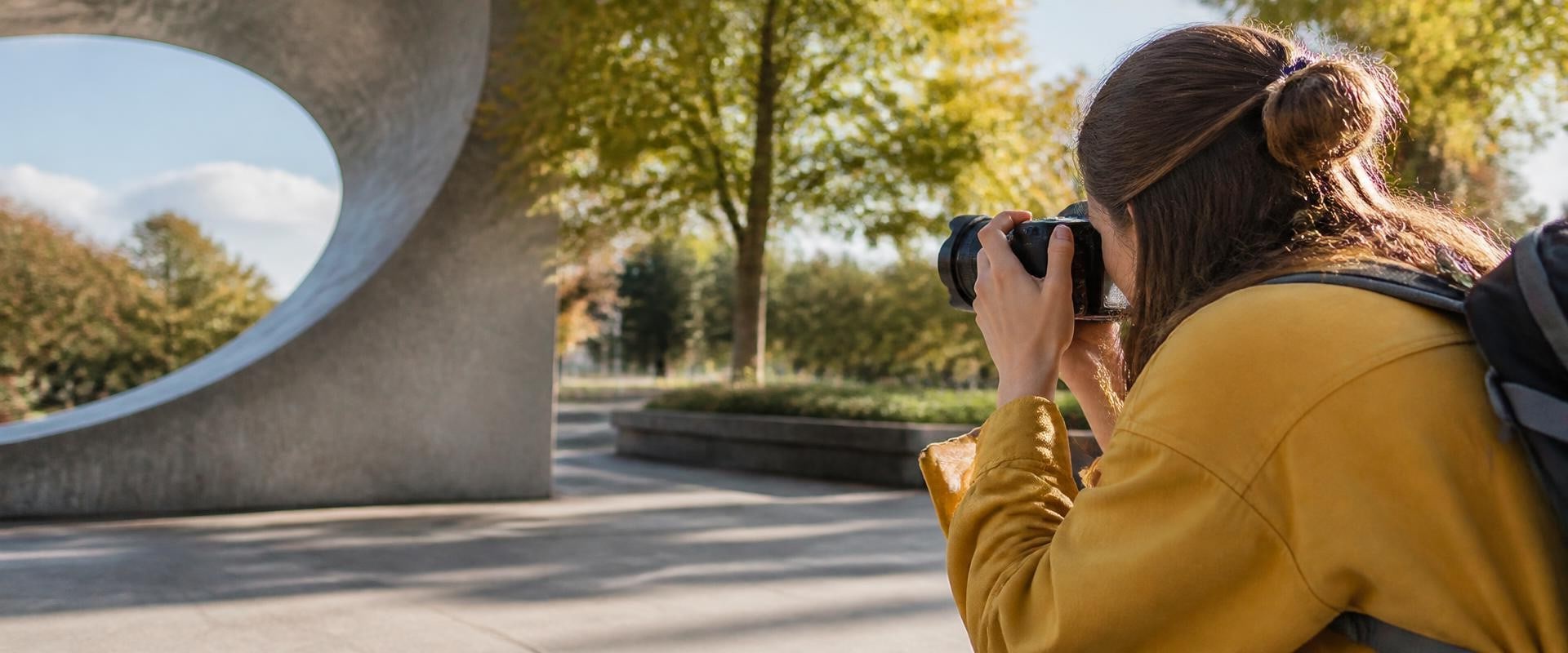
A local photo scavenger hunt gives an ordinary outing a small creative challenge: come home with pictures that answer five visual prompts. You can use a camera you already have, including the one on your phone. There is no list of landmarks to reach or objects to collect.
This hunt follows a simple sequence: pattern, contrast, reflection, detail, and distance. The scenes and finished collection described below are fictional examples. Your own answers can be completely different.
Choose a familiar route and an ending
Pick a short route you already know, with places where you are permitted to be and photograph. A familiar loop or an out-and-back route works. Decide where the hunt ends before starting, and choose conditions in which you can comfortably see both your surroundings and where you are going.
Stay on that route rather than chasing a missing picture down an unfamiliar side path. If you complete all five prompts early, finish taking photographs and enjoy the rest of the outing. If the route ends first, the hunt ends with whatever you found. An unanswered prompt does not require another lap.
Keep the five prompt names somewhere easy to consult. You can answer them in any order. Take one or two attempts for each prompt, then move on; choose your final pictures after you return.
Use five prompts that change how you look
- Pattern: three of a kind. Find one shape repeated at least three times in the same view. In an invented scene, three round openings in a railing might work. Frame enough of the repetition to make the shared shape clear. The shapes do not have to be perfectly identical.
- Contrast: two surfaces together. Show two different-looking textures in one picture. Imagine rough stone beside a smooth painted panel. Look for a view where both textures are visible, without touching or rearranging anything. The contrast should come from the surfaces rather than from an explanation added afterward.
- Reflection: color borrowed from elsewhere. Look for a patch of color reflected in a surface. An imaginary blue canopy reflected in a puddle is one possible answer. Photograph only from a stable, permitted position. Skip the prompt if the reflection would require approaching an edge, entering water, or including private details.
- Detail: a small interruption. Find a tiny feature that breaks an otherwise simple pattern. Picture one pale fleck among the dark grains of a stone surface. Make the interruption visible while leaving enough surrounding pattern to explain why you noticed it. Choose something you can see from where you safely stand.
- Distance: near and far together. Include something nearby and something farther away in one frame. For example, an invented scene could show a bench arm in front of a distant tree. Aim for two clearly separate subjects, with enough space around them to show their relationship.
Use a different photograph for each answer. A reflection might also contain repeated shapes, but choosing separate pictures gives you five reasons to look around. If an idea does not work from a safe place, leave it and try a different subject later.
Let the surroundings stay as they are
Stop in a safe place before raising the camera or checking a picture. Keep paths and entrances clear. Do not walk backward while framing, step into traffic, enter restricted areas, climb barriers, or approach wildlife for a shot.
Leave objects where they are. Do not pick plants, turn stones, move street furniture, or damage a surface to improve the composition. Choose shapes and materials that are already visible from your permitted route.
Keep people, vehicle plates, windows into private spaces, and other personal details out of your pictures. If someone enters the frame, lower the camera and wait without blocking their way, or choose another subject. These prompts can be answered with ordinary surfaces and objects.
See how one finished set could work
Imagine Rowan returning from a fictional familiar loop with these five choices:
- Pattern: Four oval gaps in a railing, all visible within the frame.
- Contrast: A ridged paving strip beside smooth paving, photographed from a clear standing place.
- Reflection: A patch of blue from a canopy reflected in a shallow puddle beside the path.
- Detail: A pale speck in a dark stone surface, with the surrounding grain still visible.
- Distance: A bench arm near the camera and a tree beyond an open lawn.
Rowan's mini-review is brief: “The four ovals make the pattern easy to see. Both paving textures show clearly. The reflection is mostly gray, so the borrowed blue takes a moment to find. The pale speck works because I left some dark stone around it. The bench and tree are separate enough to read as near and far.”
Choose the pictures, then stop
At the end, pick one photograph for each prompt you answered. Give each a short spoken or written caption explaining what caught your eye. Leave any missing prompt empty.
You can enjoy the pictures privately or compare interpretations with a companion. There is no score to maintain or collection to keep expanding. Once you have chosen your set, the activity is finished.