Draw Three Moments From a Personal Song
Turn a personal song into a three-frame drawing exercise. Choose a detail, an action and a connection, then add original captions to explain your interpretation.
Hobbies and leisure activitiesIndoor activitiesDraw Three Moments From a Personal Song
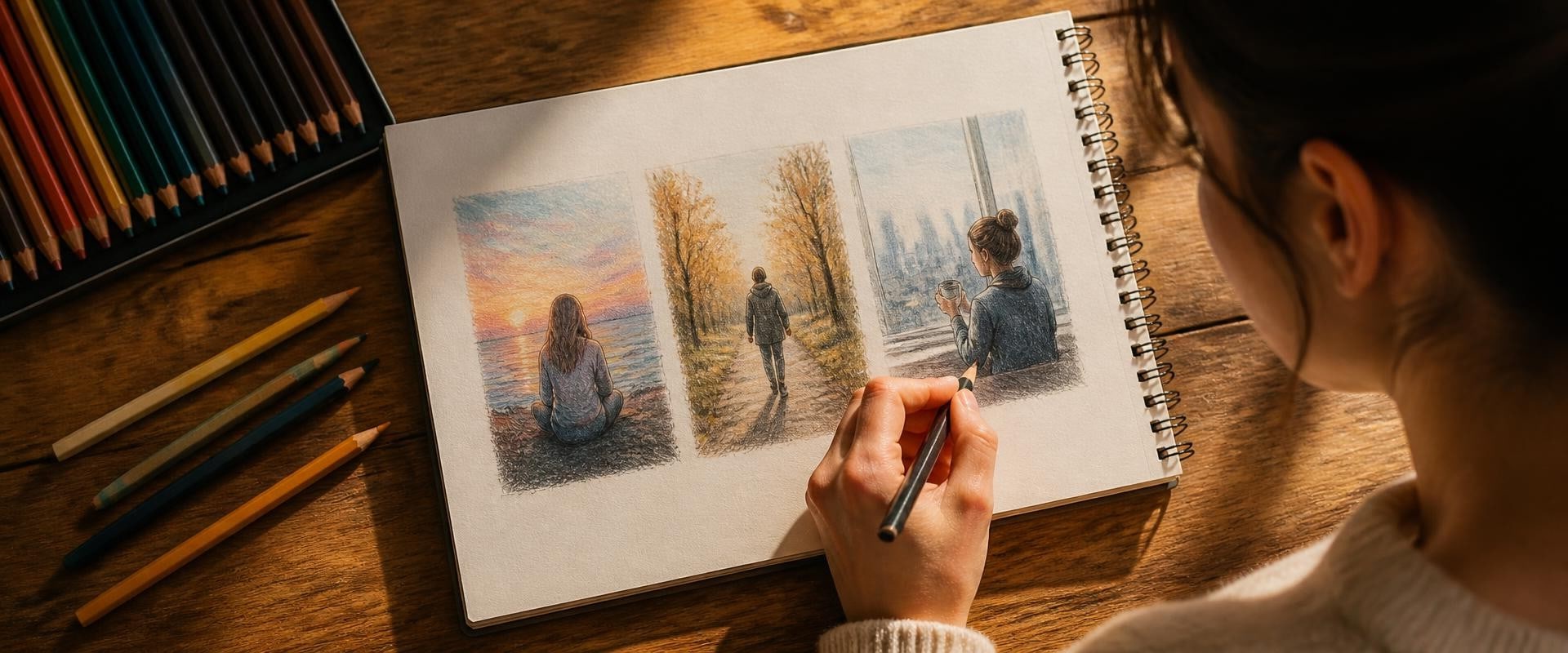
A personal song can become the starting point for a small drawing session. Instead of trying to illustrate every line, choose three moments and give each its own frame. The finished page can be a private companion to the recording, with a few images that mean something to you.
You need paper, a pencil or familiar drawing materials, and a song you are comfortable using for this activity. The method is about choosing and arranging images. It does not require realistic drawing, special software, or a finished piece suitable for display.
Choose the recording and set a boundary
Use a recording whose story you know well enough to interpret without guessing about someone else's private life. If it was made for another person, check that they are comfortable with the activity and with anyone else taking part.
A custom song can provide that personal starting point. MakeSongs offers songs based on stories and occasions you supply. Publisher disclosure: this website and MakeSongs share an owner. A song you wrote yourself is another option; choose the recording before beginning rather than making a purchase a requirement of the exercise.
Keep this first page for yourself unless everyone involved is comfortable with a wider audience. Sharing a drawing, a story, and the audio are separate decisions. Check the relevant permissions before posting or distributing any of them.
Listen for objects and actions
On the first listen, write down a few concrete things you notice: an object, a place, an action, or a change between two moments. Short notes such as “folded map,” “waiting at the gate,” or “table fills up” are enough.
Use your own descriptions instead of copying out the lyrics. Put a question mark beside anything you are unsure you heard. Replay that part if you need it, or choose another detail. The activity does not depend on proving that you caught every word.
Separate what the recording mentions from what you personally remember. Both can belong in a drawing, but a note such as “my memory, not stated in the song” keeps that distinction visible.
Choose three different kinds of frame
Draw three loose boxes with space for a short caption under each. Give the boxes different jobs:
- Frame one, a detail: one recognizable object that anchors the memory.
- Frame two, an action: something happening, shown with simple shapes or movement lines.
- Frame three, a connection: an image that shows what links this memory to another moment or to the present.
The frames do not have to form a literal beginning, middle, and end. Their different jobs keep you from drawing the same scene three times. If one needs a long explanation, simplify the image or choose a more recognizable detail.
Try an invented song story
Consider a fictional personal song about two adult friends, Bea and Luis, taking weekend walks together. The invented story mentions a red flask, a paper map unfolded at a fork in the path, and the friends adding each new route to a notebook. No real song or lyric is reproduced here.
Bea's first frame shows only the red flask, with a small dent she remembers from their trips. She labels the dent as her own remembered detail because it is not part of the invented song description.
The second frame shows two pairs of hands holding the map at different corners. Bea does not need to draw accurate portraits to show the action. A simple forked path in the background explains the choice they are making.
The third frame shows the notebook open beside the flask, with space for another route. It connects earlier walks to their ongoing habit without inventing a booked trip or a promise about where they will go next.
Make a rough version before adding detail
Give each frame a quick pencil version first. Look at the three together and ask whether their main shapes are distinguishable. Enlarge the object that matters instead of filling every gap with decoration.
Then choose one consistent finishing approach: pencil only, a single accent color, or the materials you already know. If you use color, let it help identify an object rather than trying to match the sound of the music to a supposedly correct color. Your choices are interpretations.
Listen again only if it helps you decide what to keep. You can pause the audio while drawing or work in silence. There is no requirement to finish a frame within the length of a verse.
Add captions that explain the choices
Write one short caption per frame in your own words. For the example: “The flask that came on every walk,” “Choosing a route together,” and “Room for another page.” These are original example captions, not quoted lyrics.
Add the recording's title or your own reference label and the date you made the page. Keep the drawing with your personal project notes. If you return to the activity later, try a different set of three images rather than treating this first interpretation as the only correct one.
Leanne Persten
Leanne Persten is a lifestyle writer and productivity coach who helps busy professionals reclaim their free time. With a background in organizational psychology, she writes about time management, hobby exploration, and building a fulfilling life outside of work. Leanne has been featured in several wellness publications and runs workshops on work-life balance strategies.


