Draw One Household Object Three Ways in 30 Minutes
Try an original 30-minute pencil exercise with three views of one household object, a simple comparison, and a clear stopping point.
Hobbies and leisure activitiesIndoor activitiesDraw One Household Object Three Ways in 30 Minutes
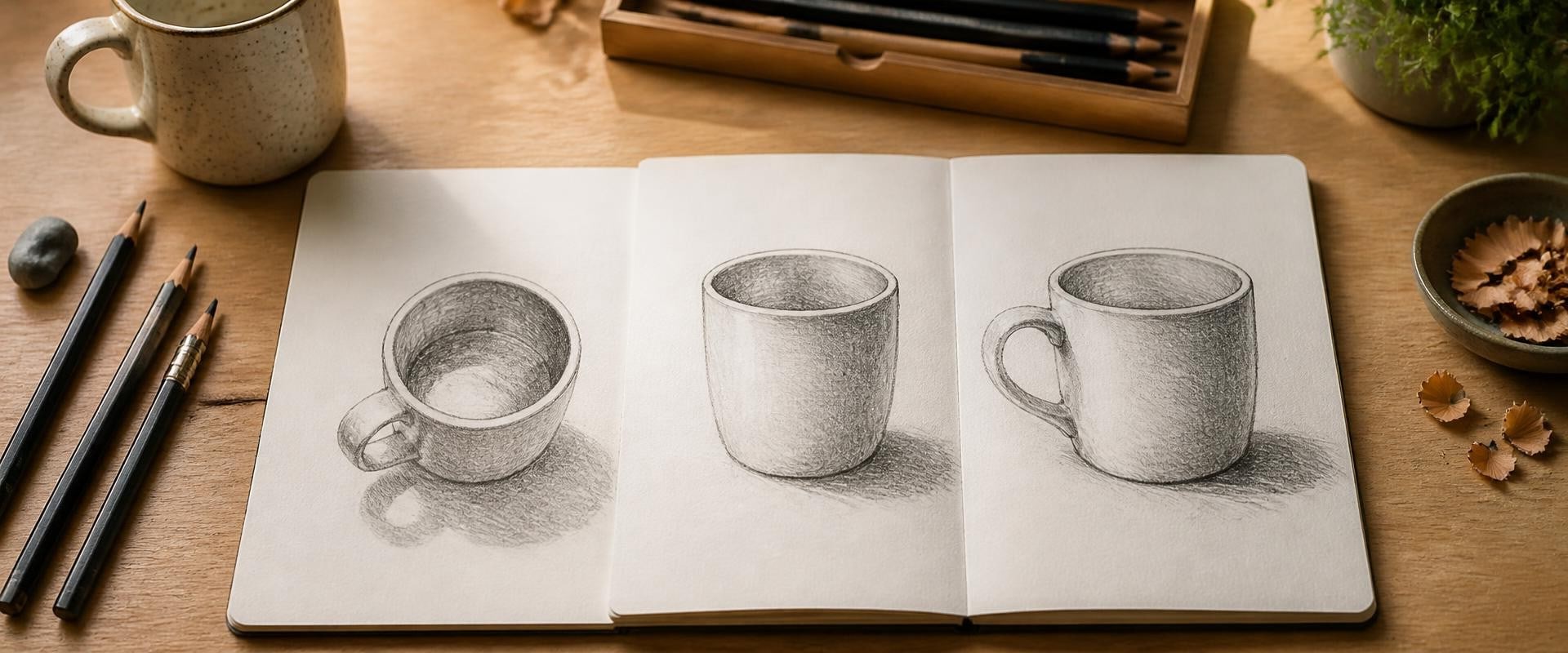
You do not need a new sketchbook project to enjoy half an hour of drawing. Use one ordinary object, three small drawing spaces, and a different question for each attempt. The aim is not to produce a polished picture. It is to notice how your drawing changes when you choose what to pay attention to.
This is a suggested exercise, not a test of ability. A mug, shoe, or folded cloth can work. Choose something you already own and can leave still. Avoid a precious or fragile object that you would worry about moving.
Set up three spaces before you begin
Divide a sheet loosely into three areas. Put the object on a stable surface where you can see it without holding it. Keep the viewpoint and lighting roughly the same for all three attempts so you can compare choices rather than three unrelated arrangements.
A pencil and ordinary paper are enough. An eraser is optional. If you already draw digitally, use a familiar brush instead of spending this session adjusting settings. Leave space beneath each drawing for one sentence.
Use the following 30-minute plan as a starting point. Five minutes are for setup, six for each of three drawings, and seven for comparison and a final small revision. If you have less time, do two drawings rather than racing through all three.
First drawing: follow the outside shape
For the first six minutes, concentrate on the outline. Look for the widest and tallest parts before adding smaller changes of direction. Notice where the object curves away, where an edge becomes straighter, and where one part overlaps another.
If you chose a mug, draw the shape of the handle opening as well as the outside edge. The empty space is part of what you are observing. Leave decoration and shading out of this attempt, even if a printed design is the most noticeable feature.
When something seems wrong, name the relationship before changing it: “The handle opening looks too narrow compared with the mug body.” That is more useful for this exercise than labeling the whole drawing good or bad. Stop when the six minutes end.
Second drawing: build from a few large shapes
In the next space, begin again. This time, ask which few simple shapes could stand in for the object. Treat them as temporary scaffolding, not as a claim that the object is geometrically perfect.
For a shoe, you might begin with a long sloping shape for the body, a smaller block for the heel, and a curve for the opening. Compare the large parts before drawing laces or seams. For a mug, compare the body width with its height before adding the handle.
Let some construction marks remain visible. This drawing records how you assembled the picture. If you use all six minutes adjusting the large shapes, that still fulfills the exercise; small details are not a required reward at the end.
Third drawing: separate light, middle, and dark
For the last six-minute drawing, make only enough outline to place the object. Then use three approximate tones: the paper for light areas, light pencil marks for middle areas, and darker marks for the darkest areas you actually see.
Do not invent a dark side simply because you expect one. Look at the arrangement in front of you. The lightest area might be small, and a printed pattern might be darker than a shadow. You are making a simplified interpretation, not identifying a universal lighting rule.
Keep the marks broad enough that you are comparing areas rather than filling tiny details. If the drawing becomes busy, leave the remaining details out.
Compare decisions, not winners
Use the final seven minutes to look at the three drawings together. Under each, finish this sentence: “This version helped me notice...” Be specific. Perhaps the outline revealed an uneven handle, the large shapes exposed a proportion problem, and the tones made an overlap easier to see.
Choose one small change for one drawing. Widen an opening, move an edge, or simplify a dark patch. Do not restart the entire exercise to erase an imperfect result.
Date the sheet and write the object you used. If you repeat the exercise another day, choose whether to keep the same object or change it. The completed page is already a record of three ways of looking, not unfinished homework.
Leanne Persten
Leanne Persten is a lifestyle writer and productivity coach who helps busy professionals reclaim their free time. With a background in organizational psychology, she writes about time management, hobby exploration, and building a fulfilling life outside of work. Leanne has been featured in several wellness publications and runs workshops on work-life balance strategies.